Automated Mixing & Dispensing Equipment
INTRODUCTION
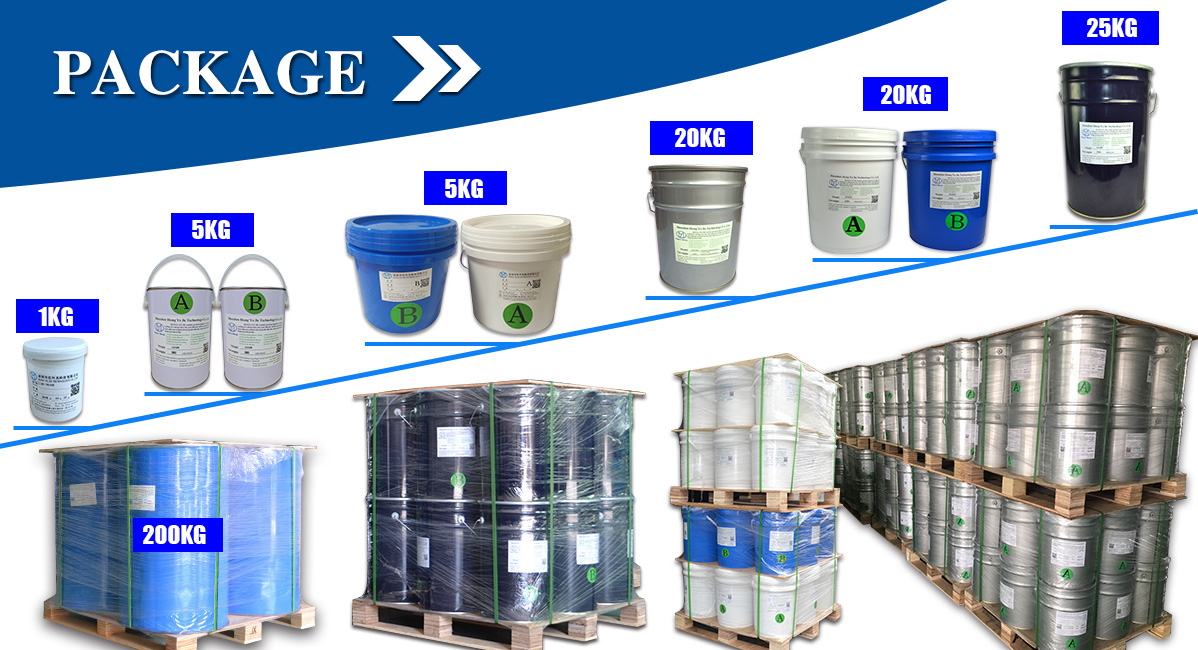
High-volume filter sealing and electronics potting lines move beyond hand mixing to meter-mix dispensing equipment that delivers Hong Ye two-component jelly gel (HY-9400, HY-9405, HY-9409) at a precise 1:1 by-weight ratio directly into channels or cavities. A typical configuration includes: bulk supply containers (200kg drums or 20kg/25kg pails with ram pumps or pressure feed); metering pumps, where gear pumps suit the 900-2600 mPa.s viscosity range of these gels while piston pumps handle higher-viscosity or filled variants; a 1:1 fixed or adjustable ratio valve with flow monitoring; a disposable static mixer tube whose element count (typically 24-32 elements) ensures complete blending without mechanical agitation; a dispensing valve or robotic gantry with path programming; and optional inline vacuum degassing or a pre-degas buffer tank for bubble-critical transparent parts. Operating time of 20-40 minutes at 25C sets pot-life management: mixed gel in lines, hoses and static mixers must be purged before the end of work pauses, while single-component flushing keeps A and B sides stable overnight. This article reviews how to size and configure such equipment for reliable gel dispensing.
PRODUCT REQUIREMENTS
Automated dispensing requires: pumps matched to gel viscosity (gear pumps for 900-2600 mPa.s); accurate 1:1 ratio control with verification; adequate static mixer elements (24-32); pot-life management with purge routines; optional vacuum degassing for transparent parts; robotic or fixtured dispense paths; and packaging suited to machine feed (pails/drums). In equipment detail, the 900-2600 mPa.s range can use gear pumps for continuous feed, with 1:1 metering and on-line display of ratio deviation. Static mixers of 24-32 elements ensure uniformity and dispensing valves cut off without dripping. The 20-40 minute operation time works with shift-change purges, and transparent parts can be vacuum degassed; robots or fixtures trace product channels, while pails and drums fit platen pumps. First pieces are checked for cure time, penetration and bubbles before volume production, with COA supplied.
CORRESPONDING PRODUCT MODEL PARAMETERS
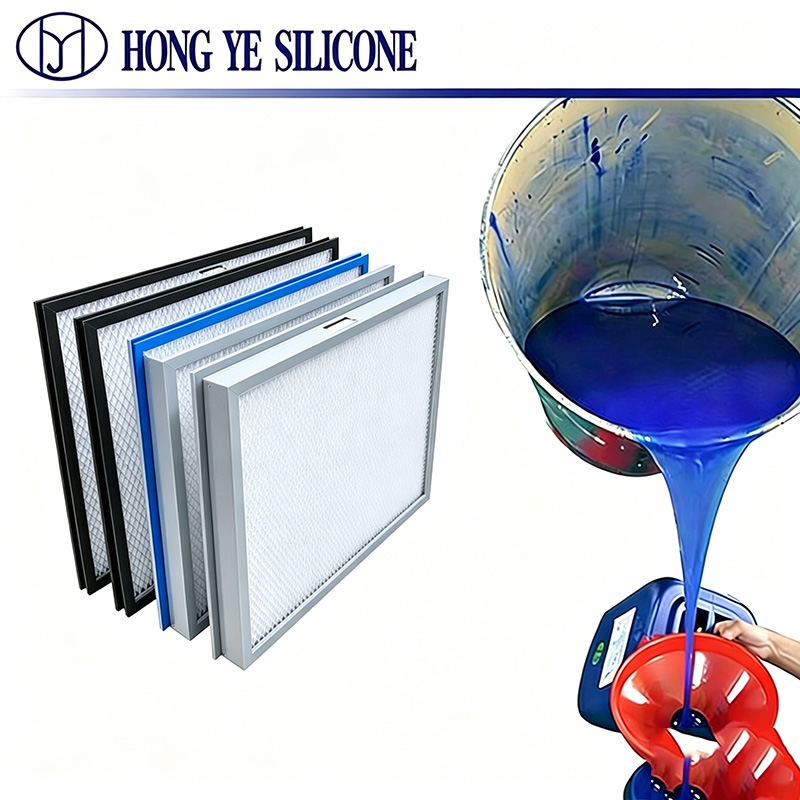
Recommended model: HY-9400 - Blue high-tack grade for HEPA/ULPA filter gel channels and cleanroom seals
|
Model |
Color |
Viscosity (mPa.s) |
Operation Time (min) |
Cure Time (hr) |
Penetration (0.1mm) |
Tack |
Mix Ratio |
Density (g/cm3) |
|
HY-9400 |
Blue |
1200+/-300 |
20-40 |
4-6 |
200+/-30 |
High |
1:1 |
0.98 |
GRADE SELECTION GUIDE
The HY-94 series offers three standard jelly gel grades for liquid-channel sealing, soft electronic potting and body-contact gel products. Their color, cone penetration, tack and typical applications are described below so users can choose the grade that matches sealing force, shape retention and processing needs.
HY-9400 is a blue grade with cone penetration 200 (0.1mm) and high tack. It is mainly used in HEPA/ULPA filter gel channels and biosafety cabinet seals, and in other applications that require strong adhesion and repeatable re-sealability.
HY-9405 is a blue grade with cone penetration 170 (0.1mm) and medium tack. It is recommended for electronic potting and sensor encapsulation, and for applications that balance softness with dimensional stability.
HY-9409 is a transparent grade with cone penetration 150 (0.1mm) and low tack. It fits transparent gel pads, intimate apparel and prosthetic devices, and other applications that require visual clarity or easy repositioning.
FREQUENTLY ASKED QUESTIONS
Q: Which pump type suits jelly gel?
A: Gear pumps handle the 900-2600 mPa.s viscosity range of HY-9400/9405/9409 well; piston pumps are used for higher-viscosity or filled custom grades.
Q: How is the 1:1 ratio maintained on automatic lines?
A: Metering pumps with ratio valves deliver 1:1 by weight; operators verify daily with catch-cup weighing and recalibrate, and component B is stirred before production.
Q: What happens to mixed gel left in the machine overnight?
A: It can cure inside hoses and mixers; lines must be purged of mixed gel before pauses beyond the 20-40 minute pot life, or flushed with single-component material per the machine procedure.
QUALITY ASSURANCE & CERTIFICATION
Every batch of Hong Ye HY-94 series jelly gel is produced under ISO 9001 certified quality management in a dedicated silicone workshop, with incoming raw-material inspection, in-process mixing control and finished-product testing on every batch. Before release each lot is checked for viscosity, mix ratio, cure time, penetration, color and tack, and a Certificate of Analysis (COA) listing the actual measured values ships with every order. Standard grades carry RoHS 2.0 and REACH SVHC test reports; skin-contact and baby-care grades can be supplied with FDA 21 CFR 177.2600 and LFGB Section 30/31 reports and, on request, ISO 10993 biocompatibility testing; flame-retardant grades meet UL94 V-0. Food-contact, medical and export orders are supported by the corresponding compliance files for customer qualification. Hong Ye has manufactured and supplied jelly gel to contractors, filter builders and equipment makers in over 60 countries since 2005, with monthly capacity above 500 tons, batch traceability and multi-language documentation. Application engineers provide grade selection, sample evaluation, on-site or video pouring guidance and after-sales follow-up, and technical data sheets (TDS), safety data sheets (SDS) and test reports are available before order to support tender and audit processes.
CONCLUSION
The market for tank sealant jelly gel in this application area continues to expand as cleanroom construction, electronic encapsulation, automotive electrification, energy storage and consumer product manufacturing drive demand for reliable two-component addition-cure silicones. Hong Ye supports this growth with ISO 9001 certified production, 500-plus ton monthly capacity, complete compliance documentation and responsive application engineering. Buyers evaluating suppliers are advised to look beyond unit price and compare batch-to-batch consistency, documentation completeness, delivery stability and technical service responsiveness, because the cost of a sealing or potting failure - rework, downtime, certification delay or product recall - far exceeds the incremental cost of a quality gel. Choosing the correct grade for the channel, operating temperature and service environment, following the 1:1 mixing and pouring procedure and validating with a small trial batch all help secure a durable seal. Hong Ye welcomes sample requests and application enquiries; our engineers will recommend the HY-9400, HY-9405 or HY-9409 grade that matches the sealing or potting requirement and support qualification from first sample through volume production.
 ∷