Sterile Air Demand Drives Treatment Gel
INTRODUCTION
The global compressed air treatment market exceeds 4 billion USD, with sterile filtration being the fastest-growing segment driven by food safety regulations such as FSMA and the EU Food Contact Framework, pharmaceutical GMP requirements for compressed gas quality per ISO 8573-1 Class 0, and semiconductor fab specifications for particle-clean process gas. Procurement teams in regulated industries are increasingly specifying gel-sealed housings because field data shows lower leak rates, fewer unplanned downtime events for seal replacement, and elimination of O-ring inventory management across multiple production lines and shift patterns. Domestic Chinese silicone gel suppliers have achieved ISO 9001 certification and serve food, pharma, and electronics clients across 60-plus countries with consistent quality at competitive pricing. For facilities managing hundreds of point-of-use filters, the switch from disposable O-rings to gel seal delivers measurable reductions in maintenance cost, inventory complexity, and contamination risk within the first year of conversion, with payback typically achieved within 6 to 12 months of initial installation. As compressed air quality standards continue to tighten, the adoption of gel-sealed housings is expected to accelerate across food, pharmaceutical, and electronics manufacturing sectors globally.
PRODUCT REQUIREMENTS
In compressed air filter housing service the gel must: hold a pressure-tight seal at the element interface across roughly 5 to 80 degrees Celsius and through repeated compressor load and unload cycles; resist condensed water, compressed-air oils, synthetic lubricants and trace oil mist without swelling or tack loss; tolerate vibration and thermal cycling without cracking; remain re-enterable for quick element changes while fully re-sealing under pressure; avoid oil bleed that could contaminate downstream sterile air; support food, pharmaceutical and electronics applications with low odor, low VOC and optional food-contact or biological compliance reports; and retain stable penetration and hardness after long-term aging, keeping bypass leakage negligible even when differential pressure rises near element replacement limits. The material should not release taste, odor or detectable oil into air streams even at elevated compressor discharge temperatures, and it should remain compatible with aluminum, zinc and engineering-plastic housing parts. Element changes should be possible by hand without special tools, and the gel should fully re-seal within minutes of reassembly. Performance should remain stable after repeated sterilizing-filter steam or hot-water sanitization cycles where such filters are installed. The gel should keep its sealing behavior through repeated rapid pressure changes caused by solenoid valve actuation and should resist trace amounts of copper-pipe thread sealants and installation greases encountered during assembly. It should not require long curing delays before housings leave the factory.
CORRESPONDING PRODUCT MODEL PARAMETERS
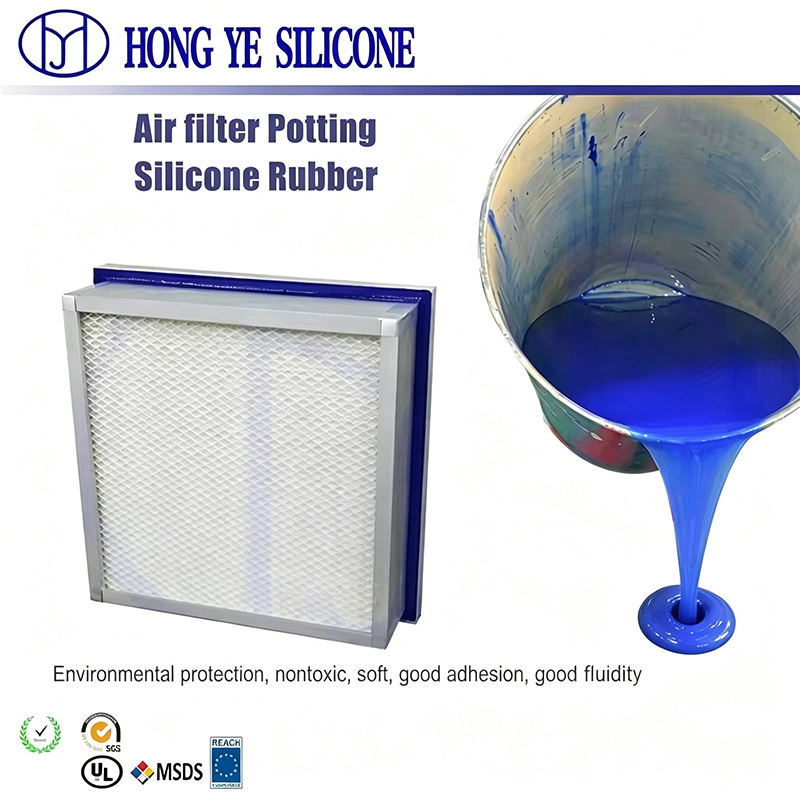
Recommended model: HY-9400 - Blue high-tack grade for compressed air and process gas filter housing gel channels requiring pressure-cycling resistance and oil aerosol compatibility.
|
Model |
Color |
Viscosity (mPa.s) |
Operation Time (min) |
Cure Time (hr) |
Penetration (0.1mm) |
Tack |
Mix Ratio |
Density (g/cm3) |
|
HY-9400 |
Blue |
1200+/-300 |
20-40 |
4-6 |
200+/-30 |
High |
1:1 |
0.98 |
GRADE SELECTION GUIDE
HY-9400 is blue, with a penetration of 200 (0.1 mm) and high tack. It is the typical choice for HEPA/ULPA filter gel channels, biosafety cabinet seals, and applications requiring strong adhesion and re-sealability.
HY-9405 is blue, with a penetration of 170 (0.1 mm) and medium tack. It suits electronic potting, sensor encapsulation, and applications balancing softness and dimensional stability.
HY-9409 is transparent, with a penetration of 150 (0.1 mm) and low tack. It is used for transparent gel pads, intimate apparel, prosthetic devices, and applications requiring visual clarity or easy repositioning.
FREQUENTLY ASKED QUESTIONS
Q: Will oil aerosol in the compressed air degrade the silicone gel seal over time?
A: Addition-cure platinum silicone gel has excellent resistance to silicone oils and moderate resistance to mineral and synthetic compressor oils. In point-of-use filter housings, the gel sits in the seal groove with only brief contact with trace oil aerosol during filter changes. Field experience shows no measurable degradation in seal performance after 24 months of service in food packaging and pharmaceutical compressed air systems.
Q: How do we switch from O-ring seals to gel seals on existing filter housings?
A: Remove the old O-ring and clean the seal groove thoroughly. Apply the 1:1 mixed gel into the groove using a dispensing gun or by pouring for larger housings. Re-clamp the lid; the gel flows to fill all irregularities. Cure takes 4-6 hours at ambient temperature before returning to full pressure service. No modifications to the housing are needed because the gel accommodates the existing groove geometry.
Q: What is the cost advantage of gel seal over O-rings for a facility with 100 point-of-use filters?
A: A facility with 100 filters replacing O-rings quarterly purchases 400 O-ring sets per year. Gel seal requires one initial fill of approximately 10-20 kg total product and lasts through multiple filter change cycles. Annual material cost drops by 60-70 percent, and maintenance labor decreases because staff no longer needs to source, stock, and install individual O-rings for each housing.
QUALITY ASSURANCE & CERTIFICATION
Every batch of Hong Ye HY-94 series jelly gel is produced under ISO 9001 certified quality management in a dedicated silicone workshop, with incoming raw-material inspection, in-process mixing control and finished-product testing on every batch. Before release each lot is checked for viscosity, mix ratio, cure time, penetration, color and tack, and a Certificate of Analysis (COA) listing the actual measured values ships with every order. Standard grades carry RoHS 2.0 and REACH SVHC test reports; skin-contact and baby-care grades can be supplied with FDA 21 CFR 177.2600 and LFGB Section 30/31 reports and, on request, ISO 10993 biocompatibility testing; flame-retardant grades meet UL94 V-0. Food-contact, medical and export orders are supported by the corresponding compliance files for customer qualification. Hong Ye has manufactured and supplied jelly gel to contractors, filter builders and equipment makers in over 60 countries since 2005, with monthly capacity above 500 tons, batch traceability and multi-language documentation. Application engineers provide grade selection, sample evaluation, on-site or video pouring guidance and after-sales follow-up, and technical data sheets (TDS), safety data sheets (SDS) and test reports are available before order to support tender and audit processes.
CONCLUSION
The market for tank sealant jelly gel in this application area continues to expand as cleanroom construction, electronic encapsulation, automotive electrification, energy storage and consumer product manufacturing drive demand for reliable two-component addition-cure silicones. Hong Ye supports this growth with ISO 9001 certified production, 500-plus ton monthly capacity, complete compliance documentation and responsive application engineering. Buyers evaluating suppliers are advised to look beyond unit price and compare batch-to-batch consistency, documentation completeness, delivery stability and technical service responsiveness, because the cost of a sealing or potting failure - rework, downtime, certification delay or product recall - far exceeds the incremental cost of a quality gel. Choosing the correct grade for the channel, operating temperature and service environment, following the 1:1 mixing and pouring procedure and validating with a small trial batch all help secure a durable seal. Hong Ye welcomes sample requests and application enquiries; our engineers will recommend the HY-9400, HY-9405 or HY-9409 grade that matches the sealing or potting requirement and support qualification from first sample through volume production.
CONTACT US
SHENZHEN HONG YE JIE TECHNOLOGY CO., LTD — Silicone Rubber Manufacturer, 23 Years
Contact: Kimi (Sales)
Mobile / WhatsApp / WeChat: 0086-18938867594
Email: hyjd@szrl.net
Website: www.szrl.net
Address: Building A, No.3, Hongling First Road, Liulian Shibi, Pingdi Street, Longgang District, Shenzhen, China
 ∷