Liquid Silicone Foam Empowers Vibration Damping and Flame
Driven by the expansion of urban rail transit, high-speed rail networks and public transport modernization, the market for interior comfort and safety materials has expanded steadily. Train interiors, bus cabins and station facilities require materials that absorb noise, damp vibration, seal gaps and reduce weight — all while meeting increasingly strict fire safety and smoke toxicity standards. As passenger expectations for ride comfort rise and vehicle structures become lighter, designers increasingly adopt high-performance foam materials for floor cushioning, wall insulation and ceiling sealing. Rolling stock manufacturers and interior suppliers have raised higher standards on material flame rating, long-term compression stability and acoustic performance. As a core interior material, liquid silicone foam from Hong Ye Silicone gains increasing importance in the transport supply chain.
Rail and public transport interiors have special working conditions. Vehicles operate under constant vibration from wheels, engines and track joints, and interior panels must withstand decades of service with minimal maintenance. Conventional polyurethane and melamine foams compress permanently, absorb moisture and degrade under heat, while their flammability and smoke emissions raise serious safety concerns in enclosed passenger compartments. In addition, interior components span large dimensions with complex curved surfaces. Poor shrinkage control of foam materials will cause dimensional deviation, panel gaps and squeaks, and frequent material replacement significantly increases cost and downtime for vehicle manufacturers.
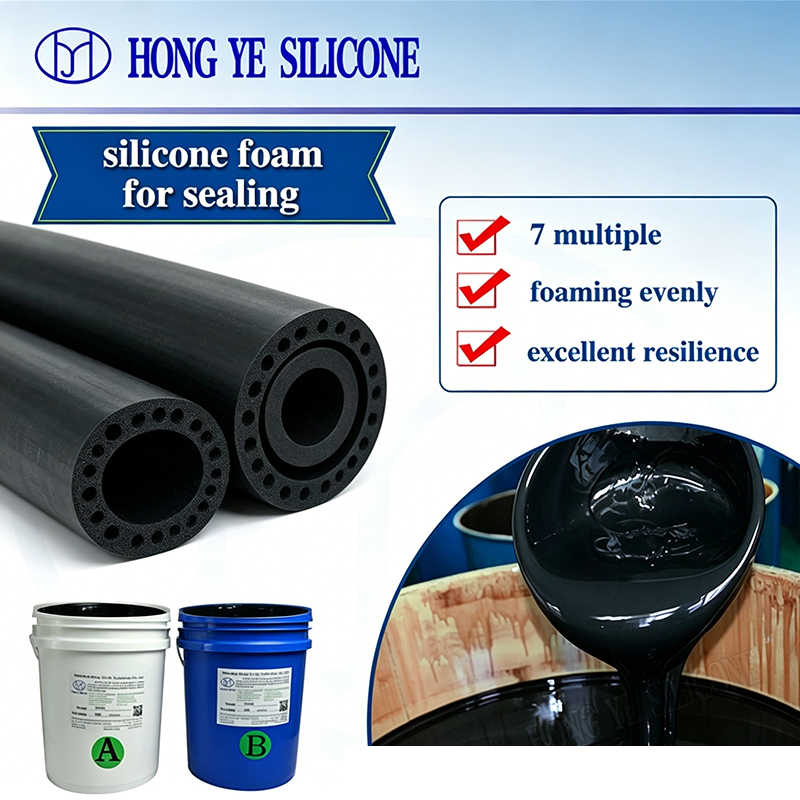
Liquid silicone foam from Hong Ye Silicone is a platinum-cured two-component addition curing silicone rubber with a formula optimized for transport interior applications. With a high expansion ratio of 2 times nominal and up to 7 times maximum, the material reduces weight and raw material consumption while maintaining reliable acoustic insulation and vibration damping. After mixing and foaming, it forms a uniform closed-cell structure with low linear shrinkage, ensuring stable dimensions after curing. Mass-produced floor cushions, wall insulation layers and ceiling seals maintain consistent size, reducing later assembly adjustment and ensuring fit precision on the production line.
In terms of mechanical performance, this foamed silicone delivers high rebound resilience and low compression set. Interior cushions undergo repeated vibration and passenger loading throughout their service life, and materials need to recover their shape after every cycle. The high-rebound formula effectively prevents permanent deformation and performance loss. The cured foam also offers inherent flame retardancy, low smoke emission, moisture resistance and chemical inertness. After long-term exposure to vibration, humidity and temperature changes, it resists aging, cracking and powdering. One component can serve for the entire vehicle lifecycle, greatly reducing maintenance cost and improving delivery efficiency for rolling stock manufacturers.
For manufacturing adaptability, this liquid silicone foam supports two mainstream processes: mold casting and continuous dispensing. For complex curved panels and large insulation layers, mold casting is widely adopted. Mixed material is poured or injected into the cavity, foams and cures at ambient or elevated temperature, and demolds as a finished cushioning or sealing component. Long linear joints and simple profiles can adopt continuous dispensing, where the two components are metered, mixed and applied directly onto the interior structure. The simple 1:1 mixing ratio and stable foaming behavior eliminate complex equipment adjustments. It can be applied by small interior workshops as well as large automated rolling stock production bases.
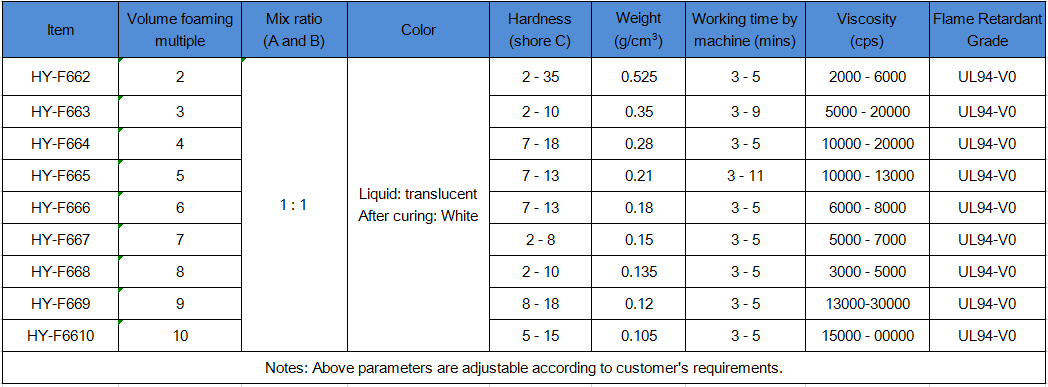
Industry trends show the global transport sector is moving toward higher comfort and stricter fire safety. Custom interior material orders from metro, high-speed rail and bus projects keep rising. Cabins become quieter and panel structures more complex. Downstream manufacturers focus not only on raw material price, but also on comprehensive indicators including flame rating, smoke toxicity, compression set and acoustic performance. Hong Ye Silicone keeps optimizing formulas, launching liquid silicone foam grades with different densities, hardness and pot life for applications ranging from thin acoustic layers to thick floor cushioning. Test documents are continuously upgraded to satisfy fire safety and environmental compliance requirements of domestic and overseas transport projects.
Industry insiders state that the final ride comfort and safety of rail and public transport interiors fundamentally depends on material quality. High-performance liquid silicone foam from Hong Ye Silicone helps convert complex acoustic, damping and sealing designs from engineering drawings into mass-producible interior components, lowering manufacturing barriers for sophisticated vehicle interiors. In the future, with the continuous advancement of urban rail networks, high-speed rail expansion and public transport electrification, the market for foamed silicone interior materials will expand further. Foam material technology will keep upgrading to support the transport industry in delivering quieter, safer and more comfortable journeys.
 ∷