Product Overview
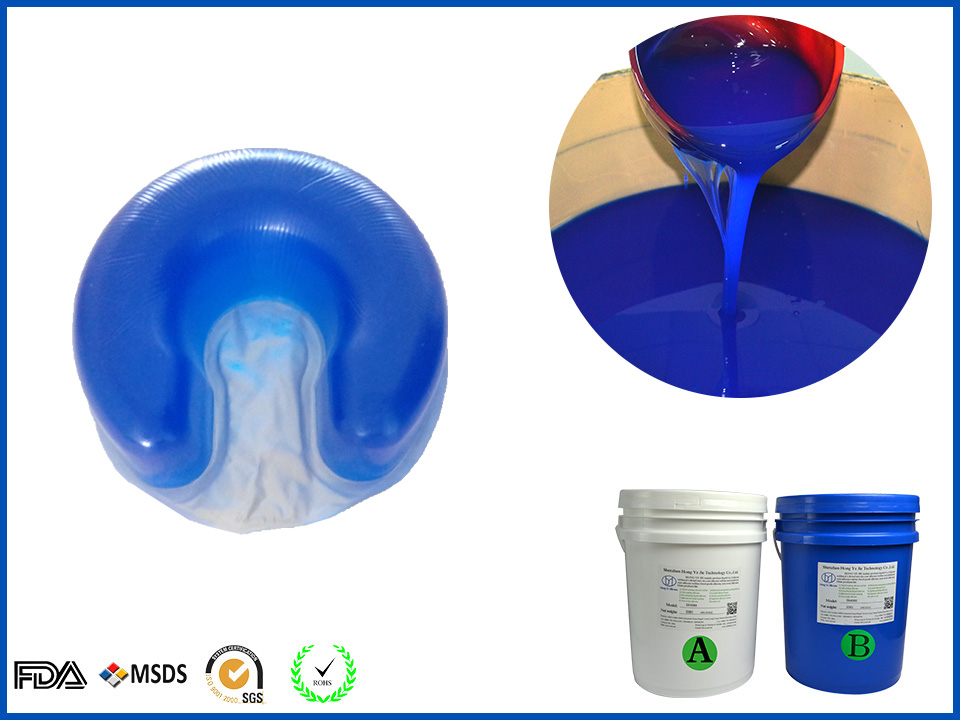
Hong Ye HY-E650 is an extra-hard (50 Shore A) addition-curing liquid silicone rubber specifically formulated for industrial mold applications that demand maximum durability, abrasion resistance, and dimensional stability. Built on a platinum-catalyzed hydrosilylation system, HY-E650 delivers the highest hardness in the Hong Ye E-Series lineup, combined with a tear strength of ≥28 kN/m and tensile strength of ≥7.5 MPa — making it suitable for casting low-melt alloys, highly filled resins, and other abrasive materials that would rapidly wear softer silicone grades.
What distinguishes HY-E650 from standard mold-making silicones is its engineered balance of rigidity and elasticity. At 50 Shore A, the cured silicone provides the structural firmness needed to resist deformation under the weight and pressure of heavy casting materials, while retaining sufficient flexibility (≥400% elongation) to release undercuts and complex geometries without tearing. The translucent formulation allows visual inspection of bubble entrapment and resin fill during casting, and the dual mix-ratio option (1:1 or 10:1 by weight) accommodates both large-format pour-in-place molds and fast-turnaround small-batch operations.
Manufactured by Shenzhen Hong Ye Jie Technology Co., Ltd. — a silicone specialist with 25+ years of experience and exports to 138+ countries — HY-E650 is fully certified to ISO 9001, FDA, REACH, RoHS, UL, and CE standards, ensuring compliance for industrial buyers in regulated markets worldwide.
Key Advantages
1. Extra-Hard 50A for Maximum Structural Support At 50 Shore A, HY-E650 is the firmest grade in the Hong Ye addition-cure lineup. This high hardness provides exceptional dimensional stability during casting — molds resist bulging, sagging, and deformation even when filled with heavy, dense materials such as low-melt alloys or highly filled epoxy resins. For production runs requiring consistent part dimensions across hundreds of casts, HY-E650 maintains tolerance far better than softer grades.
2. Industry-Leading Tear and Tensile Strength With ≥28 kN/m tear strength and ≥7.5 MPa tensile strength, HY-E650 withstands the aggressive demolding forces encountered in low-melt alloy and filled-resin casting. Sharp edges, thin fins, and deep undercuts — common failure points in softer molds — release cleanly without tearing. Field data shows HY-E650 molds delivering 1,000+ casting cycles in typical low-melt alloy production, significantly reducing per-part tooling cost.
3. Near-Zero Shrinkage for Precision Parts The platinum addition-cure mechanism releases no volatile by-products, keeping cure shrinkage below 0.1%. For precision components such as jewelry patterns, electronic connector housings, and industrial small parts cast in low-melt alloys, this means dimensional deviation of less than 0.1 mm on a 100 mm part — eliminating the need for pattern scaling adjustments and ensuring interchangeability across production batches.
4. Abrasion Resistance for Filled and Abrasive Materials Highly filled resins (with mineral, glass, or metal fillers) and low-melt alloys are abrasive to mold surfaces. HY-E650's high crosslink density and firm surface resist abrasive wear, maintaining surface finish and detail sharpness through hundreds of casts. Unlike softer silicones that develop surface roughness after 50–100 casts, HY-E650 retains a smooth cavity surface for extended production runs.
5. Thermal Stability for Low-Melt Alloy Casting Low-melt alloys (tin-bismuth, pewter, zinc) are typically cast at 100–180°C. HY-E650's service temperature range of -60°C to +200°C covers these casting temperatures, with no softening, deformation, or chemical degradation. The silicone does not react with molten alloy and provides clean, consistent release without mold coating.
6. Dual Mix Ratio for Process Flexibility
-
1:1 ratio (Part A:B): 45–60 minute pot life — ideal for large industrial molds, complex assemblies, and operations requiring time for careful pouring, degassing, and brush application to detailed surfaces.
-
10:1 ratio (Part A:B): Faster cure — suitable for small parts, rapid prototyping, and quick-turnaround production runs.
7. Translucent for Quality Control The semi-transparent appearance allows operators to visually inspect for air bubbles, incomplete filling, and cure progression during production — reducing defect rates and minimizing scrap in high-value casting operations.
Technical Specifications
表格
|
Property |
Test Standard |
Typical Value |
|
Appearance |
Visual |
Translucent |
|
Hardness |
GB/T 531 |
50 Shore A |
|
Viscosity |
GB/T 10247 |
28,000–35,000 cps |
|
Tear Strength |
GB/T 529 |
≥28 kN/m |
|
Tensile Strength |
GB/T 528 |
≥7.5 MPa |
|
Elongation at Break |
GB/T 528 |
≥400% |
|
Cure Shrinkage |
In-house Standard |
≤0.1% |
|
Service Temperature |
— |
-60°C to +200°C |
|
Mix Ratio |
— |
1:1 or 10:1 (by weight) |
|
Pot Life @ 25°C |
— |
45–60 minutes |
|
Demold Time @ 25°C |
— |
4–6 hours (2 hrs @ 60°C) |
|
Shelf Life |
Sealed, cool & dry |
12 months |
Operating Instructions
Step 1: Master Pattern Preparation Ensure the master pattern is clean, dry, and free of contaminants that can poison platinum catalyst (sulfur, tin, amines, lead, latex). For 3D-printed masters, post-cure under UV and seal with a clear barrier coat. For metal masters, remove all cutting fluids and oxidation residues. Clean with isopropyl alcohol and allow to dry fully.
Step 2: Mold Framing and Parting Setup Build a containment frame around the pattern, leaving 10–15 mm clearance for the silicone wall. For two-part molds, establish a clay parting wall along the maximum contour line and insert registration keys (cones or notches) at 30–50 cm intervals. Seal all frame joints with clay or hot melt adhesive to prevent leakage.
Step 3: Release Agent Application Apply a thin, even coat of platinum-compatible release agent to the pattern and frame surfaces. Avoid over-application, which can cause surface defects. Allow 10–15 minutes flash-off before silicone application.
Step 4: Weighing and Mixing Calculate required silicone volume (pattern surface area × wall thickness × 1.2 safety factor). Weigh Part A and Part B at the selected ratio. Mix slowly in one direction for 2–3 minutes, scraping container sides and bottom to ensure complete homogenization.
Step 5: Vacuum Degassing Degas at -0.095 MPa for 2–3 minutes. For large industrial molds requiring several kilograms, mix and degas in batches to maintain sufficient pot life and avoid overflow.
Step 6: Brush Coat and Build-Up Apply a thin first coat (1 mm) of degassed silicone to the pattern using a brush, working into all details, sharp edges, and undercuts. Allow this coat to tack up (20–30 minutes), then apply 2–3 additional coats to build a total wall thickness of 4–6 mm. For large or heavy molds, embed fiberglass cloth in the second coat for added structural reinforcement.
Step 7: Mother Mold (Support Shell) Once the silicone is fully cured (4–6 hours at 25°C), apply a rigid mother mold using fiberglass and resin, or plaster bandages. The mother mold should follow the silicone contour closely and include reinforcement ribs for large sections. This support shell prevents the flexible silicone from deforming under the weight of heavy casting materials.
Step 8: Demold and Post-Cure Remove the mother mold, then carefully peel the silicone from the pattern. Start from parting line edges and work gradually toward complex features. Allow the mold to post-cure for 12–24 hours before production use to maximize mechanical properties — especially important for HY-E650's high-hardness matrix.
Step 9: Production Use For low-melt alloy casting, preheat the mold to 50–80°C to improve alloy flow and reduce cooling rate variation. Apply a light release agent (dry graphite or silicone spray) for alloy casting; for resin casting, use appropriate wax or PVA release. Clean the mold between casts with a soft brush and compressed air.
Typical Applications
-
Low-Melt Alloy Casting — Tin, bismuth, pewter, and zinc alloy parts for jewelry, electronics, fishing lures, and industrial components
-
Centrifugal Casting — Jewelry findings, metal buttons, zipper pulls, decorative hardware, and small mechanical parts
-
Rigid & Filled Resin Tooling — Highly filled epoxy and polyurethane parts requiring abrasion-resistant molds
-
Industrial Small Parts — Connector housings, grommets, seals, bushings, and prototype mechanical components
-
Master Patterns — Positive masters for vacuum forming, thermoforming, and secondary mold making
-
High-Volume Production Molds — Long-run production where softer grades would wear out prematurely
-
Concrete & Cement — Small-format architectural concrete pieces requiring high dimensional repeatability
Certifications
-
ISO 9001:2008 Quality Management System
-
FDA Food Contact Material Compliance (21 CFR)
-
REACH EU Chemicals Registration
-
RoHS Restriction of Hazardous Substances
-
UL Safety Recognition
-
CE European Conformity
Packaging, MOQ & Logistics
表格
|
Package |
Size |
Typical Use |
|
Bottle |
1 kg |
Sampling, prototyping, small workshops |
|
Pail |
5 kg |
Small-batch production, jewelry studios |
|
Drum |
20 kg |
Standard production size for industrial users |
|
Drum |
25 kg |
Bulk economy option for high-volume operations |
-
MOQ: 2 kg (sample and trial orders accepted)
-
Lead Time: 3–7 working days (stock); 10–15 days (custom formulations)
-
Shipping: Non-hazardous cargo; sea freight, air freight, and express (DHL / FedEx / UPS) worldwide
-
Payment: T/T, L/C, Western Union, Alibaba Trade Assurance
-
Customization: Color, hardness, viscosity, and pot life can be tailored to specifications
-

 ∷
∷