Reliable Platinum Silicone for Molds Supplier Which is Better
A mold maker requests three quotes for platinum silicone for molds. One quote is surprisingly cheap, one sits in the middle, and one comes with full certificates and a slightly higher number. All three suppliers describe themselves as reliable. In 2026, deciding which is better requires looking past the quotation sheet and examining how each supplier actually operates.
This guide explains what makes a platinum silicone for molds supplier reliable, compares the main supplier types, and gives practical selection advice for buyers in food molds, GRC, candles, soap, and resin crafts.
## What Reliable Platinum Silicone Should Deliver
Platinum cure silicone, also called addition curing silicone, vulcanizes through a platinum catalyst rather than a tin-based system. The chemistry matters because it determines shrinkage, safety, and mold life.
Near-zero shrinkage: A reliable batch should reproduce master dimensions accurately. Shrinkage becomes visible on large parts and accumulates across repeated casts, so dimensional stability is a core indicator of supplier quality.
High tear and tensile strength: Molds are flexed, twisted, and pulled during demolding. Strong material survives more cycles and reduces replacement frequency.
Correct hardness for the job: The HY-E style range runs from 10A to 50A. Soft grades suit chocolate, candy, and fine candles; middle grades suit resin crafts, soap, and cultured stone; firm grades suit GRC and large concrete elements.
Food safety where needed: Food contact molds require chemically inert, odorless material backed by real FDA documentation, not a logo pasted on a brochure.
## Certifications Worth Verifying
Professional buyers treat certificates as baseline requirements and verify them independently:
ISO9001 quality management systems, FDA clearance for food contact applications, REACH and RoHS for European markets, UL recognition for relevant industrial uses, and CE documentation. A dependable supplier provides certificate numbers, TDS, SDS, and COA paperwork with each shipment rather than vague reassurance.
## Comparing Supplier Types
The market has three common supplier categories. Each has trade-offs:
| Dimension | Trading Company | Small Workshop | Scaled Factory |
|-----------|----------------|----------------|----------------|
| Price | Markup over factory source | Low quote, variable cost later | Mid-range, volume terms |
| Batch consistency | Depends on upstream source | Changes between batches | Controlled across runs |
| Certificates | Passed along, hard to verify | Often incomplete | Own certificates, checkable |
| Customization | Relayed requests, slow answers | Flexible but unvalidated | Structured sampling process |
| Hardness range | Few stocked grades | Limited | Full 10A-50A spectrum |
| Export handling | Moderate experience | Limited | Own export license |
| Issue response | Multiple intermediaries | Unpredictable | Direct technical contact |
The comparison suggests a pattern. For buyers who need repeated orders, export paperwork, and predictable performance, a scaled factory removes most of the coordination risk. A facility with around 20 production lines, roughly 6000 square meters, and about 220 tons of monthly silicone capacity can hold viscosity and hardness tolerances more tightly than a single-line operation.
## Which Supplier Is Better for Each Application
Food-grade molds: Choose a supplier with verifiable FDA documentation and platinum cure chemistry. Grades of 10A to 20A release chocolate, candy, and cake decorations cleanly and capture fine texture. Ask for the certificate number and confirm it independently.
GRC and concrete work: Prioritize firm grades from 35A to 50A, near-zero shrinkage, and suppliers experienced with alkaline casting materials. Large architectural panels leave no room for dimensional drift.
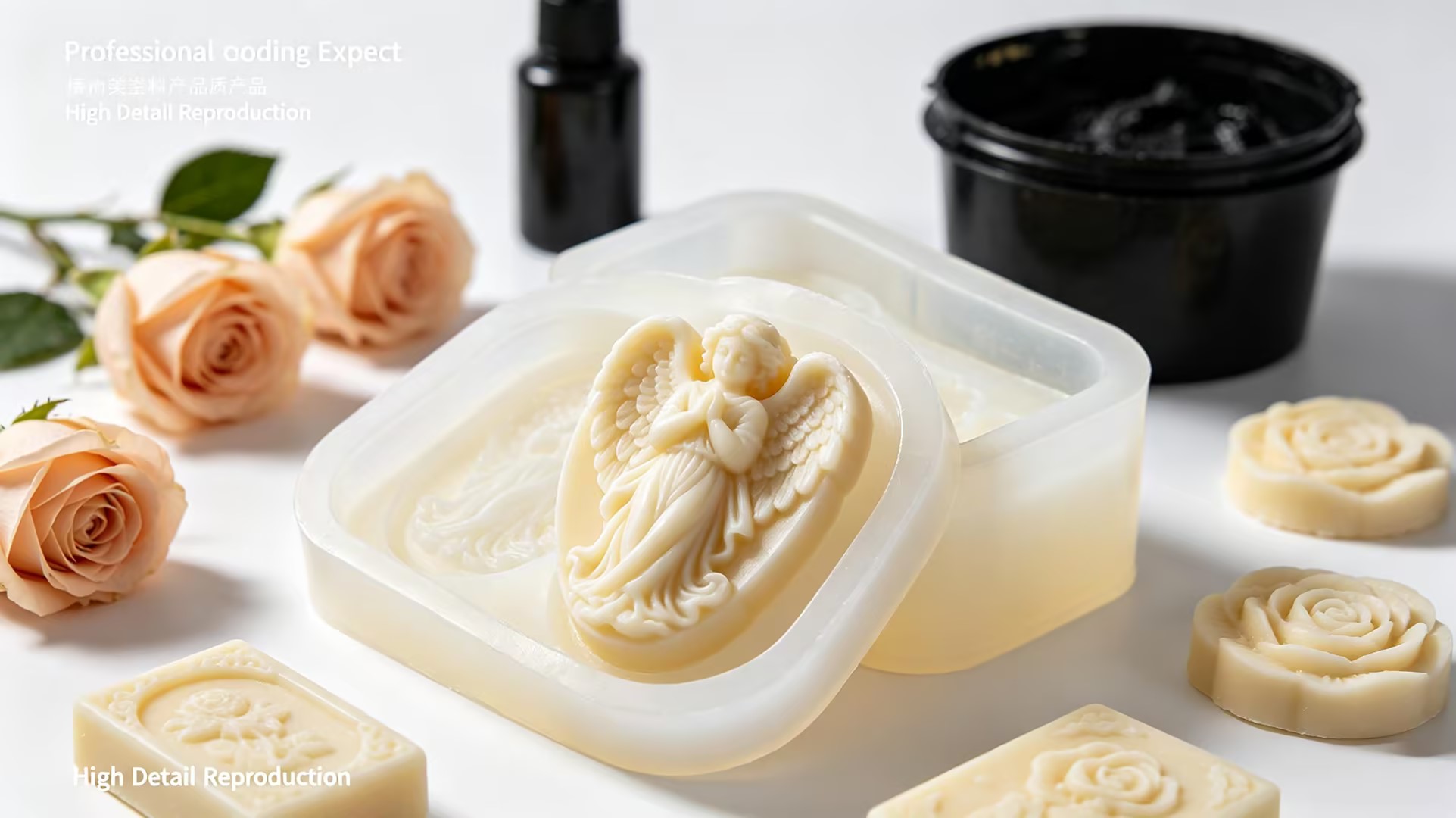
Candles and soap: Grades from 15A to 25A balance detail capture and durability through repeated pours. Check color matching capability if branded mold color matters.
Resin and epoxy crafts: Look for chemical resistance to epoxy and polyester, good release behavior, and medium grades around 25A to 30A. Platinum systems typically show lower shrinkage than tin-cured alternatives.
## Practical Evaluation Steps
First, order a small sample. A 2kg trial quantity is enough to test mixing behavior, cure time, hardness, demolding, and surface finish under real workshop conditions.
Second, verify documents yourself. ISO registrars and FDA databases allow independent checks. Photocopies without traceable numbers carry little weight.
Third, inspect the communication pattern. Technical questions answered within about a day with structured documents indicate operational discipline. Slow, vague answers usually predict slow handling of production problems.
Fourth, scale gradually. A 20-50kg trial order validates packing, logistics, and batch consistency before monthly volume commitments.
## Closing Thoughts
In 2026, the better platinum silicone for molds supplier is the one whose scale, certificates, and process can be checked, not the one with the loudest claims. The price gap between a verified factory and an unverified source is usually modest compared with the cost of failed molds and delayed orders. Buyers comparing reliable suppliers can search for HONG YE SILICONE to review technical documentation, the HY-E hardness range, and sample options from a manufacturer supplying silicone to 138 countries.
 ∷
∷