Pad Printing Head Manufacturing Process Guide How to Make Hig
Preparation is very important for making high quality pads. First is pad mold preparation, mold quality directly determines pad shape and surface quality. The mold must be thoroughly cleaned to remove dust, oil, residual silicone and other impurities, wiped with alcohol or special cleaner. Then apply mold release agent evenly, thin and uniform without accumulation, leave 5 to 10 minutes to dry fully. Insufficient release agent causes difficult demolding, excessive release agent affects pad surface quality. Place mold on a level stable surface.
Second is material preparation, selecting the right pad printing silicone model is fundamental. Choose corresponding hardness silicone based on product shape, printing requirements and production volume. For flat and slightly curved products choose medium high hardness like Hongye HY-902 or HY-912, for large curved surfaces choose ultra soft Hongye HY-916, for small batch multi variety production choose economy Hongye HY-901. Before use, stir component A base rubber thoroughly for 1 to 2 minutes as fillers may settle, stirring ensures uniform color and filler distribution. Gently shake component B curing agent before use.
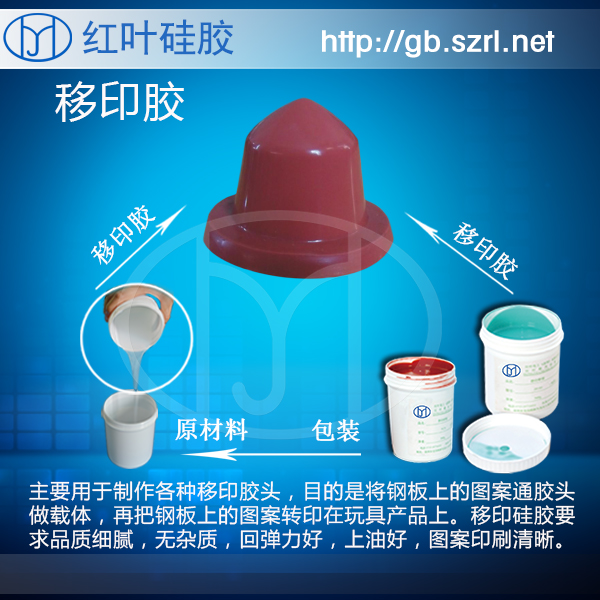
Key Points of Weighing and Mixing
Weighing and mixing are the most critical steps in pad manufacturing, directly affecting curing quality and pad performance. Hongye pad printing silicone standard mixing ratio is 100:2 (A:B by weight), must be accurately weighed with electronic scale within ±5 percent tolerance, do not estimate ratio by feel. Excessive component B causes hard brittle pads with shortened life, insufficient component B causes incomplete curing, sticky pads and unstable performance.
Mixing must be thorough and uniform, stir for 3 to 5 minutes, constantly scraping container walls and bottom to ensure complete uniform mixing throughout. Uniform mixing is indicated by completely consistent color with no streaks, color blocks or uneven color. Moderate stirring speed, too fast creates excessive air bubbles, too slow results in uneven mixing. Keep stirring rod submerged below rubber surface during stirring to avoid entraining air. Pour promptly after mixing as working time is generally 30 to 40 minutes.
Pouring and Degassing Techniques
Pouring and degassing determine whether bubbles exist inside the pad, bubbles are one of the most common pad defects causing pinholes and missing patterns during printing. When pouring, slowly pour mixed silicone from one side of the mold, let rubber flow naturally to fill the mold, avoid pouring from high position that splashes and creates bubbles. Fill to about 80 percent, do not overfill, leave space for degassing and cover plate.
Degassing is the key step for making high quality bubble free pads. If vacuum equipment available, place poured mold in vacuum chamber at negative 0.09MPa for 2 to 3 minutes until rubber surface stops bubbling. Observe during vacuuming, rubber will expand and rise, release pressure and re vacuum if necessary to avoid overflow. Without vacuum equipment, let poured mold sit 5 to 10 minutes for natural bubble release, or use low temperature heat gun to gently sweep rubber surface to help bubbles break. After degassing, gently cover the mold.
Curing Demolding and Post Treatment
Curing time depends on temperature, at room temperature 25°C generally 2 to 4 hours before demolding. Lower temperature extends curing time, higher temperature shortens it. For faster curing, place mold in 60°C oven for 30 to 60 minutes, but temperature must not exceed 100°C as excessive temperature affects pad performance. Gently remove pad after curing, do not pull forcefully to avoid tearing. Newly demolded pads need to rest 24 hours for full performance stabilization before use, early use affects printing results and pad life.
Pad post treatment includes surface cleaning and shape trimming. Before use, gently wipe pad surface with alcohol to remove dust and oil. Do several test prints on waste paper before first use to condition the pad surface and reach stable state. If pad shape has minor burrs or irregularities, gently trim with fine sandpaper but do not over polish affecting surface quality. Store pads for different products separately, wrap surface with plastic film when not in use, store in cool dry place.
Common Defects and Prevention Methods
Common defects in pad manufacturing include bubbles, uneven hardness, incomplete curing, sticky surface, deformation etc. Bubbles are the most common defect, caused by air entrained during stirring, improper pouring method, insufficient degassing, dust on mold. Prevention methods include moderate stirring speed, slow pouring from one side, thorough vacuum degassing, clean mold. Uneven hardness caused by insufficient mixing, unstirred component A, inaccurate weighing. Prevention methods include thorough stirring of component A before use, accurate weighing, scraping container walls and bottom during mixing.
Incomplete curing and sticky surface caused by insufficient component B ratio, uneven mixing, low temperature, insufficient curing time. Prevention methods include accurate 100:2 ratio weighing, thorough mixing, ensuring curing temperature and time, resting 24 hours after demolding before use. Pad deformation caused by unlevel mold, pressure during curing, premature demolding, improper storage. Prevention methods include level mold placement, no pressure during curing, full curing before demolding, avoid squeezing during storage. Understanding these common defect causes and prevention methods effectively improves pad manufacturing qualification rate.
Hongye Silicone Pad Manufacturing Technical Support
Hongye Silicone has focused on liquid silicone for over 20 years, providing full series pad printing silicone products and technical support for various industries. The company has a professional technical service team with average industry experience over 10 years, providing full process technical support from model selection to pad manufacturing process optimization, including pad mold design review, manufacturing process training, common defect troubleshooting, printing parameter adjustment etc. Hongye also provides 1kg trial kits for companies to test before bulk purchasing. As pad printing industry continues to develop, Hongye Silicone will continue R&D innovation to provide higher quality pad printing silicone products and professional technical services.
 ∷
∷