Automotive ECU Low Stress Soft Gel Encapsulation Trends
1 Introduction
Automotive ECU soft gel encapsulation. Global demand for premium two-component jelly gel is growing at double digit rates, driven by cleanroom construction in semiconductors and biopharma, smart meter rollouts, automotive electronics electrification, and the continued expansion of intimate apparel, swimwear and medical gel pad markets. Soft gel reduces stress on MLCCs by over 70 percent compared with hard epoxy, cutting capacitor cracking failures in thermal shock testing. Hong Ye HY-9405 is positioned as a cost-effective alternative to German Wacker SilGel and American Magna-Dyne gels, offering comparable penetration, tack and clarity at 30 to 50 percent lower unit price, with 3 to 5 working day lead time versus 8 to 12 weeks for imported materials.
This market trend report covers demand drivers, supply chain dynamics and adoption patterns shaping the blue tank sealant gel market in this application area. Demand for two-component addition-cure jelly gel continues to expand across cleanroom, electronics, automotive and consumer product sectors.
2 Product Requirements
In this application, the gel sealant must meet the following requirements:
• Permanent tack and self-healing: remain soft and adhesive throughout service life, re-sealing after module replacement without re-pouring.
• Self-leveling viscosity of 1200-2000 mPa·s allows the gel to flow into narrow channels and corners without vacuum assistance.
• Wide service temperature range of -60°C to 200°C ensures reliable performance in outdoor and industrial environments.
• Low shrinkage below 0.1% with no condensation by-products eliminates voids, odor and corrosion risks.
• Strong electrical insulation: dielectric strength above 20 kV/mm and volume resistivity above 10^14 Ω·cm.
• Chemical resistance against ozone, UV radiation, moisture, salt spray and common disinfectants.
• Regulatory compliance: RoHS 2.0 and REACH SVHC as baseline; FDA 21 CFR 177.2600 and LFGB available for food-grade or skin-contact grades.
3 How Hong Ye Jelly Gel Solves the Problem
Hong Ye HY-9405 addresses these requirements through a combination of material formulation design and application engineering support. Three market shifts are accelerating adoption of Chinese jelly gel. First, cleanroom and filter contractors are under pressure to reduce bill-of-material cost while meeting GMP, SEMI and hospital certification requirements; domestic gels with full SGS documentation and five-year field track records are now accepted in most projects. Second, meter and sensor OEMs need repairable, low-stress encapsulation that supports IP67 and IP68 designs without the brittle failure mode of hard epoxy; soft jelly gel has become the default choice for new outdoor electronic platforms. Third, intimate apparel and medical brands are regionalizing their supply chains and looking for factories that can support custom colors, skin-safe grades and fast sampling, all of which favor responsive Chinese manufacturers.
Beyond standard operating procedures, Hong Ye provides on-site pouring guidance, custom formulation for volume projects and batch-to-batch Certificate of Analysis verification. The three key success factors in this application are: (1) selecting the correct viscosity and penetration grade for the channel geometry, (2) enforcing strict 1:1 ratio and clean-tool discipline to prevent platinum inhibition, and (3) maintaining the recommended 18-35°C pour temperature. When these conditions are met, field data consistently shows zero leakage over five or more years of service.
4 Corresponding Product Model Parameters
HY-9405 — blue, medium tack
Appearance: blue soft jelly gel
Cone Penetration: 170±20 (1/10 mm)
Viscosity (A/B mixed): 1500±300 mPa·s
Mixing Ratio: Part A : Part B = 1 : 1 by weight
Working Time: 20-40 min at 25°C
Cure Time (RT): 4-6 h at 25°C
Heat Cure: 30-60 min at 60-80°C
Hardness / Feel: cone penetration 170 (soft)
Density: 0.97 g/cm³
Linear Shrinkage: <0.1%
Service Temperature: -60°C to 200°C
Dielectric Strength: >20 kV/mm
4.2 Grade Selection Guide
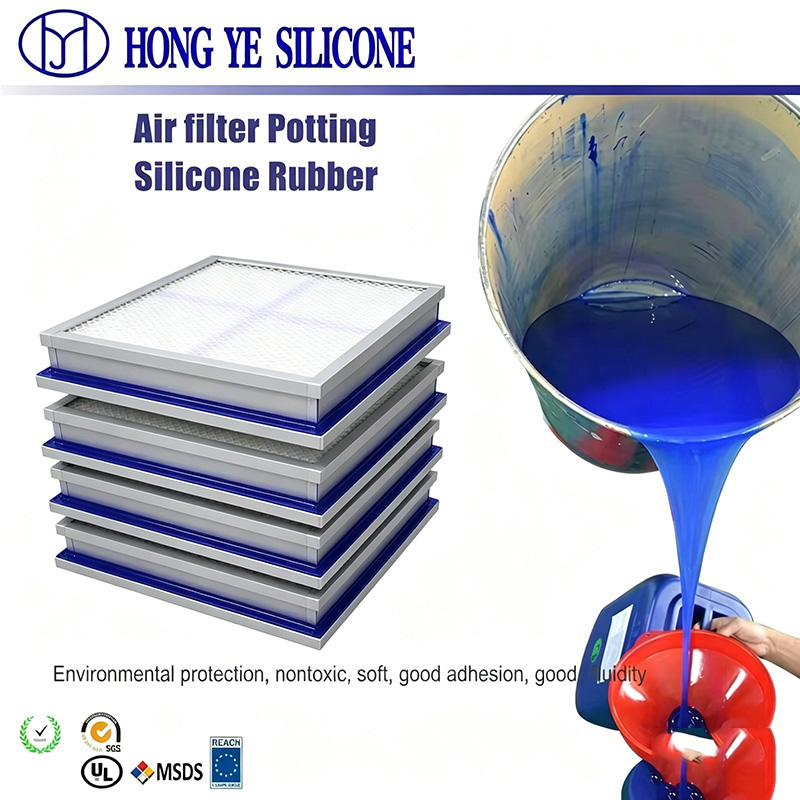
• HY-9400 (blue, cone penetration 200): highest tack and softness; the standard choice for HEPA filter gel channels, biosafety cabinet seals and any application requiring maximum adhesion and re-sealability.
• HY-9405 (blue, cone penetration 170): medium tack and firmness; suitable for electronic potting, sensor encapsulation and applications requiring a balance of softness and dimensional stability.
• HY-9409 (transparent, cone penetration 150): lowest tack and firmest feel; preferred for transparent gel pads, intimate apparel, prosthetic devices and applications requiring visual clarity or easy repositioning.
5 General Technical Parameters
Product Type: Two-component addition-cure platinum-catalyzed silicone jelly gel (RTV-2)
Mixing Ratio: Part A : Part B = 1 : 1 by weight
Cure System: Platinum addition cure, no condensation by-products
Viscosity (mixed): 1200-2000 mPa·s depending on grade
Cone Penetration: 150-200 (1/10 mm)
Working Time: 20-40 minutes at 25°C
Cure Time: 4-6 h at 25°C; 30-60 min at 60-80°C
Operating Temp: 18-35°C recommended for pouring
Service Temp: -60°C to 200°C continuous
Linear Shrinkage: <0.1%
Dielectric Strength: >20 kV/mm
Volume Resistivity: >1×10^14 Ω·cm
Thermal Conductivity: 0.18-0.22 W/(m·K)
Self-Leveling: Yes, no vacuum degassing required
Self-Healing: Yes
Shelf Life: 12 months sealed below 25°C
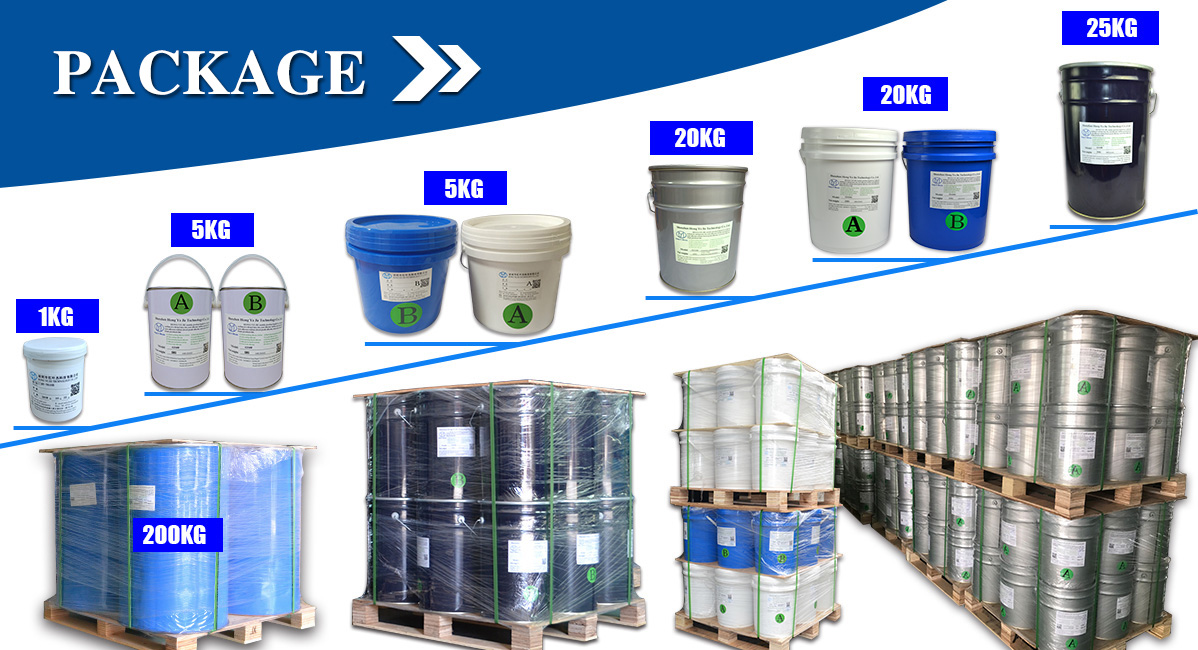
Packaging: 1kg, 5kg, 20kg, 25kg, 200kg kits (A+B)
6 Manufacturing Process
6.1 Surface Preparation
Clean all contact surfaces with isopropyl alcohol or acetone to remove grease and dust. Ensure surfaces are completely dry before pouring.
6.2 Component B Stirring
Stir Component B thoroughly for at least 2 minutes before each use. Color paste and platinum catalyst may settle during storage.
6.3 Weighing
Weigh A and B at 1:1 by weight on a calibrated digital scale, accuracy within ±2%.
6.4 Mixing
Mix slowly and thoroughly for 2-3 minutes, scraping sides and bottom. Avoid high-speed mixing that entraps air.
6.5 Degassing (Optional)
HY-94 is self-leveling; vacuum degassing generally not required. For optical/electronic critical use, degas at -0.08 MPa for 3-5 min.
6.6 Pouring
Pour slowly along one end, maintaining 5-10 cm height above surface. Ambient temp 18-35°C.
6.7 Curing
4-6 h at 25°C, or 30-60 min at 60-80°C. Do not disturb until fully cured.
6.8 Inspection
Check uniform color, complete fill, no sticky areas. Properly cured gel is smooth, glossy and uniformly soft.
6.9 Cleanup
Clean tools with isopropyl alcohol before cure. Cured gel is removed mechanically. Wear PE/nylon/nitrile gloves; avoid natural latex.
7 Frequently Asked Questions
Q: Why is my cured gel sticky or soft in some areas?
A: Usually inaccurate 1:1 ratio, insufficient mixing, or unstirred Component B. Sulfur/tin/amine/phosphorus contamination inhibits platinum cure. Use clean dedicated tools.
Q: Can I cure faster with heat?
A: Yes, 30-60 min at 60-80°C. Do not exceed 100°C to avoid surface skinning and trapped bubbles.
Q: Is vacuum degassing needed?
A: Generally no. HY-94 self-levels and self-degasses. Only optical or high-voltage electronic applications may require vacuum.
Q: What is the shelf life?
A: 12 months sealed below 25°C away from sunlight. Reseal after opening and use within 3 months. Always stir B before use.
Q: Is it safe for skin contact?
A: HY-9400 and HY-9405 can meet FDA 21 CFR 177.2600 and LFGB requirements on request. Standard grades meet RoHS 2.0 and REACH SVHC.
Q: What is the coverage of a 20kg kit?
A: Approximately 60-100 standard 610×610mm HEPA modules. Formula: channel length × width × depth × 0.97 g/cm³.
Q: Can cured gel be repaired?
A: Yes. HY-94 self-heals after minor displacement. For major repairs, remove contaminated gel, clean with isopropyl alcohol and re-pour fresh gel.
8 Quality Assurance & Certification
• ISO 9001 certified manufacturing facility in Shenzhen with 20,000 square meters of production area.
• Monthly addition-cure silicone capacity exceeding 500 tons, ensuring stable supply for volume orders.
• Every batch is released with a Certificate of Analysis covering viscosity, cone penetration, cure time, color and tack.
• Documented quality control procedures span incoming raw material inspection, in-process monitoring and finished-product testing.
• Technical team with an average of 10 or more years of silicone industry experience provides formulation and troubleshooting support.
• Custom formulation, color matching and private-label or neutral packaging are available for volume customers.
8.2 Certifications & Compliance Documents
• RoHS 2.0 — restriction of hazardous substances in electrical and electronic equipment.
• REACH SVHC — EU chemicals regulation compliance.
• ISO 9001:2015 — quality management system certification.
• FDA 21 CFR 177.2600 — available on request for food-contact and skin-contact grades.
• LFGB — available on request for food-grade applications in the European market.
• MSDS/SDS — safety data sheet provided with every shipment.
9 Conclusion
The market for blue tank sealant jelly gel in this application area continues to expand as cleanroom construction, electronic encapsulation, automotive electrification and consumer product manufacturing drive demand for reliable two-component addition-cure silicones. Hong Ye supports this growth with ISO 9001 certified production, 500-plus ton monthly capacity, complete compliance documentation and responsive application engineering. Buyers evaluating suppliers should prioritize batch consistency, documentation completeness and technical service responsiveness over unit price alone, as the cost of a sealing failure far exceeds the incremental cost of a quality gel.
 ∷
∷