Well-known RTV-2 silicone rubber supplier review list
An RTV-2 supplier list is easy to collect and hard to use. A buyer searching for two-component silicone usually ends up with twenty names, a stack of quotations for the same nominal hardness, and no obvious way to tell which of them will still answer the phone in month eight.
The quotes rarely separate the suppliers. What separates them is what happens after the first order.
Why RTV-2 Buying Differs from Buying a Commodity
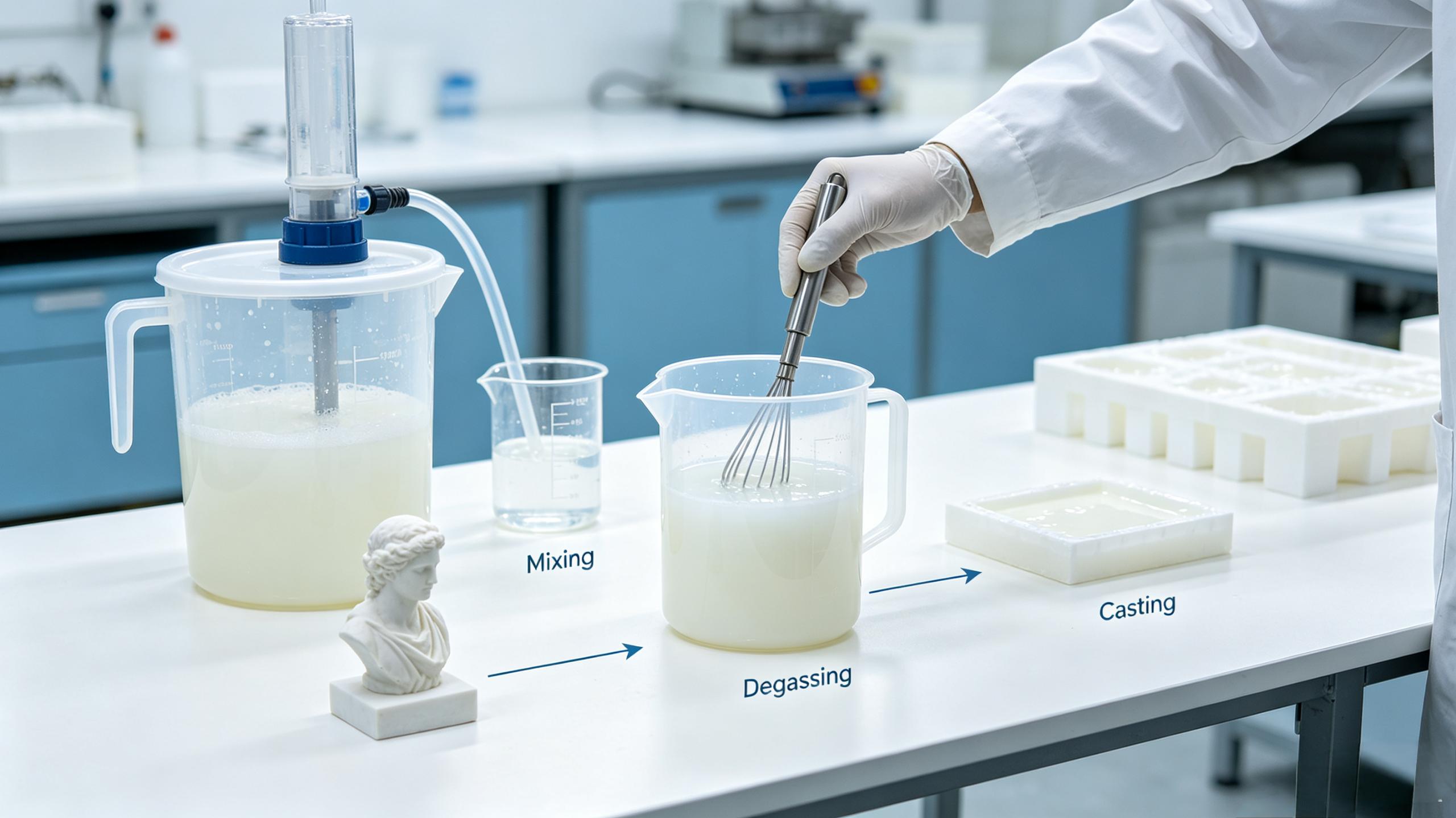
RTV-2 silicone rubber cures at room temperature after two components are mixed. That single property means the buyer, not the supplier, finishes the manufacturing step. Mixing ratio, working time and cure behaviour all land on the workshop floor.
Because of that, a supplier review has to cover two things at once: whether the material itself is right for the job, and whether the supplier will behave consistently when the second and third orders arrive.
Four Checks Worth Completing Before You Order
Certificate scope, not certificate count. A supplier may hold several approvals, but only the one covering the exact grade being quoted matters. Food contact requirements differ between Europe and North America, and a document issued for a sibling grade does not transfer.
Batch linkage. If one drum cures faster than the rest, can the supplier identify the production run it came from? A supplier who answers without hesitation is running a quality system. One who offers general reassurance is running a sales process.
Hardness stability across orders. Moulds are thin-walled and detailed. A two-point drift in Shore A hardness changes how the material releases from a finished part. This shows up on the fifth order, not the first sample.
Trial path. Minimum order quantity, sampling lead time and whether pre-production sampling is offered decide how fast a buyer can validate material without committing to volume.
How Supplier Types Differ on Documentation
The comparison below is not about competence. It is about where the paperwork originates, which is what determines how quickly an answer arrives when something goes wrong.
|
Dimension |
Trading intermediary |
Integrated manufacturer |
|
Certificate handling |
Forwarded from the source, often without batch linkage |
Issued against the production run |
|
Batch traceability |
Depends on the upstream factory |
Held in house, retrievable per shipment |
|
Customization request |
Relayed upstream, longer loop |
Adjusted internally at the mixing stage |
|
Schedule control |
Subject to the source's allocation |
Allocated on own mixing capacity |
|
Problem resolution |
Requires a third party in the loop |
Answered by the party who made the material |
For standard grades in small quantities, an intermediary can be genuinely responsive. The friction appears when a buyer needs customization, batch documentation, or a delivery commitment held to a schedule.
A second axis is worth separating: scale. A workshop mixing to order can reproduce a first sample faithfully and still struggle by the tenth order, because nothing about the process is recorded. Recorded mixing parameters, retained batch samples and inspection before shipment are what make order ten resemble order one.
Matching Grade to Application
Hardness is the fastest way to narrow an RTV-2 selection, and it follows the mould rather than the product category.
Fine detail and food contact work sits at the softer end of the range, where the material must release from thin sections and embossed surfaces. Documentation for food contact has to cover the grade being quoted.
Craft and decorative moulds sit in the middle band. It balances detail reproduction against mould life well enough for workshop production.
Large architectural and cement parts sit at the firmer end. These moulds carry weight and need dimensional stability more than flexibility.
A buyer who writes down the mould size, the relief depth and the expected number of casts per week will narrow the grade faster than any catalogue can.
What to Do Next
Start with the application, then ask for a sample against that specification. A trial batch from 10kg is enough to test release, detail and cure behaviour under real production conditions, and it costs far less than discovering a documentation gap after a container has shipped.
Shenzhen Hong Ye Jie Technology produces addition curing platinum silicone rubber across the 10 to 50 Shore A range for mould making applications, working with buyers who begin with a trial quantity and scale once the material has proven itself in their own process.
Silicone, Rubber, Mold Making, RTV-2 Silicone, Platinum Silicone

 ∷
∷